Castle in the Sky
Vibe
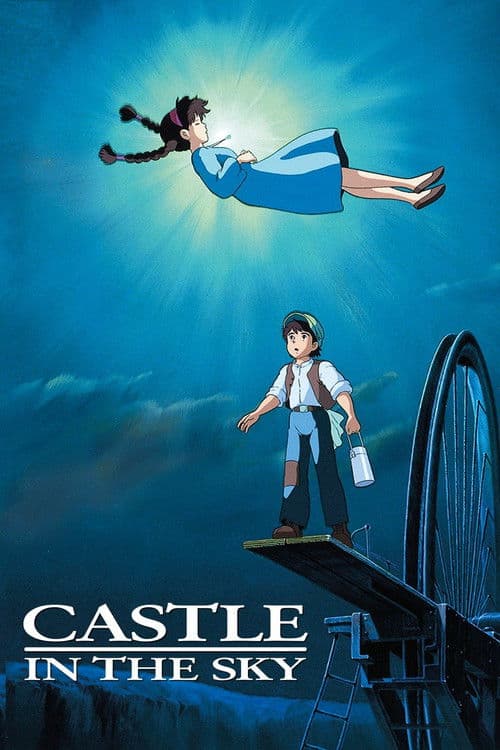
Hayao Miyazaki’s adventure fantasy follows Sheeta, a young girl carrying a mysterious crystal, and Pazu, an idealistic boy who dreams of finding the legendary floating city of Laputa. As soldiers, pirates, and government agents close in, the two are drawn into a race that transforms childhood wonder into a struggle over power, memory, and the meaning of lost civilizations. The film pairs exhilarating aerial set pieces with a sense of old-world mechanical charm, creating a world that feels both grand and handmade. With its blend of innocence, danger, and awe, Castle in the Sky becomes a story about friendship, greed, and the enduring hope that wonder can survive human ambition.
Watch for
- The chemistry between Sheeta and Pazu, whose shared curiosity and decency keep the film emotionally grounded even as the adventure grows larger and stranger.
- How Miyazaki designs flight itself—gliders, airships, collapsing bridges, and floating ruins—so that movement through space becomes one of the film’s great sources of excitement and wonder.
- The evolving meaning of Laputa, which begins as an object of dream and ambition but gradually becomes a test of how different characters understand power, beauty, and responsibility.
- The way nature quietly reclaims the floating city, turning the film’s lost civilization into a visual meditation on what remains after human grandeur and violence fall away.
Production notes
Castle in the Sky was Studio Ghibli's first official production after its 1985 founding, with Hayao Miyazaki directing, Isao Takahata producing, and Toshio Suzuki coordinating from Tokuma Shoten (which had funded the studio's establishment). Miyazaki developed the screenplay from his own longstanding fascination with sky-cities, drawing on Jonathan Swift's Gulliver's Travels (the floating island Laputa) and on Welsh mining culture from a 1984 research trip. The film's airships and flying machines reflect Miyazaki's lifelong aviation obsession; his father had run an aircraft parts factory during the war. Joe Hisaishi composed the score, and Mayumi Tanaka voiced Pazu while Keiko Yokozawa played Sheeta. The English-language Disney dub, recorded in 1998 and released on home video in 2003, featured James Van Der Beek, Anna Paquin, Cloris Leachman, and Mark Hamill. The film took approximately fifteen months to animate.
Trivia
- Castle in the Sky was Studio Ghibli's first official production after the studio's 1985 founding; its release in August 1986 effectively launched the new company's theatrical operations.
- The film's title was modified for English-language territories to avoid an unfortunate similarity between 'Laputa' and a Spanish profanity; in original Japanese the film is simply Laputa: Castle in the Sky.
- Miyazaki took a 1984 research trip to Welsh mining towns following the U.K. miners' strike, and the film's underground mining-town setting and the mining culture of the surface dwellers are direct visual quotations from that trip.
- The 'Laputa Day' phenomenon — in which thousands of Japanese fans collectively chant 'Balse!' (the spell of destruction) at exactly the right moment during Friday Roadshow's annual TV broadcast — has become one of Japan's most distinctive shared media rituals, occasionally setting Twitter records for tweets per second.
- The English-language Disney dub was completed in 1998 but held from release until 2003 due to ongoing translation disputes; Studio Ghibli ultimately rejected the first dub and required substantial revisions before allowing release.
Legacy
Castle in the Sky establishes the visual grammar that would define Studio Ghibli for the next four decades — the impossible flying machines, the lush green landscapes, the strong young protagonists, the morally ambiguous adult worlds, the patient pacing — and remains one of the most beloved entry points to the Ghibli catalog for new viewers. It grossed approximately ¥1.16 billion at the Japanese box office and has continued earning theatrical revenue across multiple re-releases. The 'Laputa Day' phenomenon — Japanese fans collectively shouting the spell of destruction during synchronized TV broadcasts — has become one of the most distinctive shared media rituals in Japanese culture, occasionally setting global Twitter activity records. The film entered the National Film Registry equivalent in Japan. Among Miyazaki's films, Castle in the Sky is the one most explicitly engaged with the romance of flight and the moral cost of weaponized technology — themes that Miyazaki would return to repeatedly across his career, reaching their fullest expression in The Wind Rises (2013).