Earwig and the Witch
Vibe
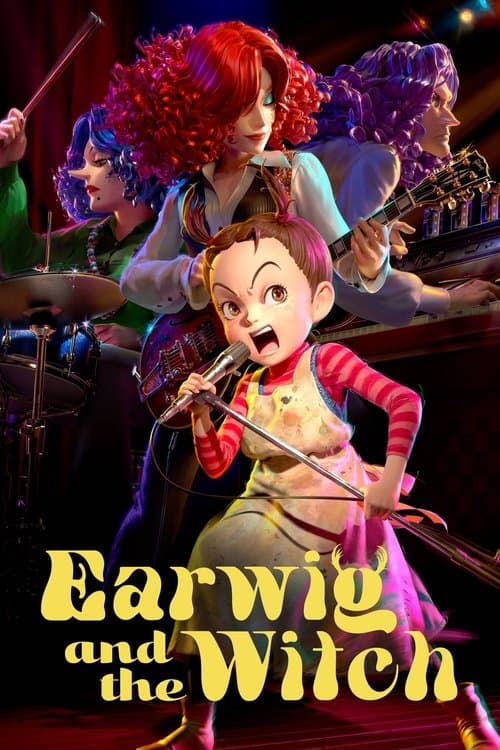
Gorō Miyazaki’s fantasy comedy follows Earwig, a clever and strong-willed orphan whose confidence is tested when she is taken from the only home she has known and sent to live with a witch and a mysterious companion in a house full of secrets, spells, and shifting power. As Earwig tries to turn her new circumstances to her advantage, the film leans into mischief, stubbornness, and the pleasure of watching a resourceful child refuse to be intimidated by adults or magic. Its smaller scale and domestic setting give the story a more contained energy, centered less on grand adventure than on personality clashes and hidden motives. With its playful defiance and impish charm, Earwig and the Witch becomes a story about independence, adaptability, and the strange households where power, curiosity, and identity collide.
Watch for
- Earwig’s confidence and resourcefulness, especially the way she treats a house full of magic not with awe but as a system to be tested, manipulated, and gradually understood.
- The domestic scale of the film, where spells, secrets, and power struggles are all concentrated inside a cluttered household rather than spread across a larger fantasy world.
- The tension between Earwig, Bella Yaga, and Mandrake, which gives the story much of its energy by turning everyday chores, rules, and hidden histories into ongoing tests of will.
- How the film’s mischievous tone depends on Earwig’s refusal to be passive, making her less a child swept into magic than an active force reshaping the strange home she has been thrown into.
Production notes
Earwig and the Witch was Studio Ghibli's first fully 3D CGI feature — a substantial departure from the studio's traditional hand-drawn animation tradition that had defined every previous theatrical release. Goro Miyazaki directed his third Ghibli feature, after Tales from Earthsea (2006) and From Up on Poppy Hill (2011). Hayao Miyazaki served as planning director. The film adapted Diana Wynne Jones's posthumously-published 2011 novel of the same name (Jones had also written the source for Howl's Moving Castle). The CGI production was developed by Goro Miyazaki and a team of Ghibli animators learning the new techniques; the visual approach was deliberately styled to evoke hand-drawn animation rather than the photorealistic rendering of Pixar or DreamWorks. Shinobu Terajima voiced Earwig, with Etsushi Toyokawa as the Mandrake. Composer Satoshi Takebe scored the film. Earwig was originally produced for Japan's NHK television rather than for theatrical release; the film's eventual U.S. theatrical premiere through GKIDS was substantially delayed by the COVID-19 pandemic.
Trivia
- Earwig and the Witch was Studio Ghibli's first fully 3D CGI feature, marking a substantial departure from the studio's traditional hand-drawn animation tradition; the visual approach was deliberately styled to evoke hand-drawn animation rather than photorealistic rendering.
- The film was originally produced for Japan's NHK television rather than for theatrical release, and aired on Japanese TV in December 2020; its U.S. theatrical premiere through GKIDS was substantially delayed by the COVID-19 pandemic.
- Diana Wynne Jones, the source novelist, had previously written Howl's Moving Castle (1986), which Miyazaki had adapted in 2004; Earwig was her posthumously-published 2011 novel, written shortly before her death in March 2011.
- The film received the most negative critical reception of any Studio Ghibli feature — its Rotten Tomatoes score sits around 28%, the lowest in the studio's entire catalog; reviews focused particularly on what critics described as the limitations of the CGI approach.
- Despite the negative reception, Earwig and the Witch was Studio Ghibli's first foray into the 3D animation tradition that has come to dominate global mainstream animation; the film's experimental nature has been viewed by some critics as a necessary if unsuccessful first step rather than as a permanent stylistic destination.
Legacy
Earwig and the Witch is widely regarded as Studio Ghibli's least successful feature, both critically and commercially. Its Rotten Tomatoes score of approximately 28% is the lowest of any Ghibli feature, and the film's commercial reception in both Japan (where it aired on NHK in December 2020) and internationally was modest. Critically, the film's transition to 3D CGI was seen by most reviewers as a step backward from the studio's hand-drawn tradition rather than as a genuine stylistic evolution. The film's existence has nonetheless had institutional significance: it represents Studio Ghibli's first attempt to engage with the 3D animation tradition that has come to dominate global mainstream animation, and it positioned Goro Miyazaki to continue working in ways the senior studio's traditional commitments had not allowed. The 2023 Nippon TV acquisition of Studio Ghibli, which followed Earwig by three years, has been speculated to have been informed in part by the studio's struggle to evolve toward CGI without losing its identity. Among Ghibli's films, Earwig is the one most often cited in discussions of stylistic experimentation gone wrong.