From Up on Poppy Hill
Vibe
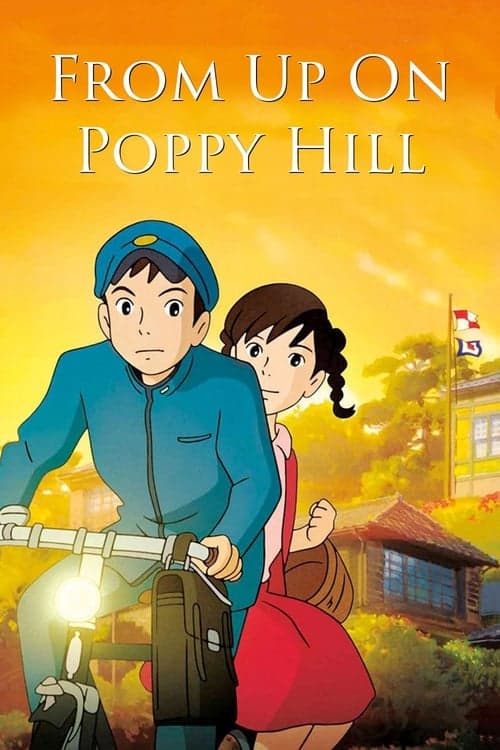
Gorō Miyazaki’s nostalgic drama follows Umi, a responsible high school girl in 1960s Yokohama, whose daily routines of school, home, and quiet remembrance are interrupted when she becomes involved with Shun and a student effort to save an old clubhouse from demolition. As affection grows between them and unexpected truths begin to surface, the film balances youthful romance with a broader portrait of postwar Japan, where memory, renewal, and the future are all in conversation with one another. Its harbor setting, period detail, and measured rhythms give the story a lived-in warmth that makes its emotional turns feel intimate and sincere. With its gentleness and historical texture, From Up on Poppy Hill becomes a story about first love, remembrance, and the desire to protect what still gives a community its soul.
Watch for
- How the film’s harbor setting, school routines, and domestic rituals create a lived-in sense of postwar everyday life, giving nostalgia a social and historical texture rather than treating it as simple sentiment.
- The energy of the Latin Quarter restoration scenes, where clutter, noise, teamwork, and youthful conviction turn a threatened old building into the emotional heart of the film.
- The gradual shift in Umi and Shun’s relationship, especially the way affection grows through shared purpose, mutual respect, and an increasing awareness of the past’s hold on the present.
- How the story balances lightness and melancholy, using first love and student activism to explore the deeper question of what a generation chooses to preserve before modernization sweeps it away.
Production notes
From Up on Poppy Hill was Goro Miyazaki's second feature as director — his redemption project after Tales from Earthsea's 2006 critical and commercial disappointment. Hayao Miyazaki wrote the screenplay this time, and the father-son relationship during production was reportedly substantially more functional than during Earthsea. The film adapts Tetsurō Sayama and Chizuru Takahashi's 1980 manga, locating the story in 1963 Yokohama just before the Tokyo Olympics — a moment of intense Japanese self-modernization that shaped the film's nostalgic register. Production took approximately two years and was disrupted by the March 2011 Tōhoku earthquake and tsunami; Studio Ghibli's Mitaka facility lost power and water, and the team continued production by candlelight when possible. Masami Nagasawa voiced Umi and Junichi Okada played Shun. Composer Satoshi Takebe scored the film. The Disney English-language dub featured Sarah Bolger as Umi, Anton Yelchin as Shun, and Beau Bridges, Christina Hendricks, and Bruce Dern.
Trivia
- From Up on Poppy Hill was Goro Miyazaki's redemption project after Tales from Earthsea's 2006 critical disappointment; Hayao wrote the screenplay this time, and the father-son working relationship was reportedly substantially more functional than during the earlier troubled production.
- The film's production was disrupted by the March 2011 Tōhoku earthquake and tsunami; Studio Ghibli's Mitaka facility lost power and water, and the team continued production by candlelight when possible — making it the only Ghibli feature partially animated under post-disaster emergency conditions.
- The Disney English-language dub featured Anton Yelchin as Shun in one of his earlier voice acting roles; Yelchin would die tragically in 2016 at age 27, and From Up on Poppy Hill became one of the more notable entries in his abbreviated filmography.
- The film is set in 1963 Yokohama just before the Tokyo Olympics — a moment of intense Japanese self-modernization that the film treats with substantial nostalgia; the period-detail research was extensive, with Ghibli's team consulting newspapers, photographs, and oral histories from the era.
- The film's central plotline — Umi and Shun discovering they may share a father, then having to navigate that revelation while their feelings for each other grow — was reportedly retained from the source manga at Goro Miyazaki's specific insistence, against some studio reservations.
Legacy
From Up on Poppy Hill significantly rehabilitated Goro Miyazaki's directorial reputation after Tales from Earthsea's 2006 disappointment. The film grossed approximately ¥4.46 billion at the Japanese box office and received warm critical reviews, particularly for its nuanced period sensibility and its restrained tone. The Tōhoku earthquake-affected production has become a celebrated story of Ghibli resilience, and the film's release later in 2011 was treated as a kind of cultural consolation for the disaster's emotional aftermath. Critically, the film has been celebrated for its careful period detail and its quiet emotional confidence — qualities that distinguish it from Goro's earlier troubled debut. Among Ghibli's contemporary-realism films (alongside Whisper of the Heart, Only Yesterday, and Ocean Waves), From Up on Poppy Hill represents the studio's most thoroughgoing engagement with mid-20th-century Japan as historical setting. The film also set the template for Goro Miyazaki's continuing directorial career — including his subsequent Earwig and the Witch (2020), which would mark Ghibli's first 3D CGI feature.