Grave of the Fireflies
Vibe
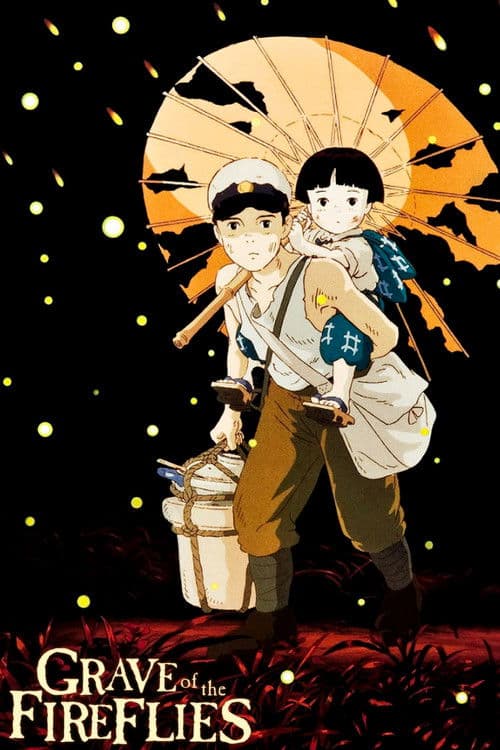
Isao Takahata’s wartime drama follows Seita and his younger sister Setsuko, two children struggling to survive in Japan during the final months of World War II after losing their home and family support. As their circumstances grow more desperate, the film strips away sentimentality and confronts the human cost of war through small, intimate details of hunger, pride, tenderness, and loss. Takahata’s quiet realism makes every fleeting moment of comfort feel precious, turning ordinary gestures into devastating emotional landmarks. With its restraint, compassion, and unflinching honesty, Grave of the Fireflies becomes a heartbreaking story about innocence, responsibility, and lives destroyed long before they ever had the chance to fully begin.
Watch for
- How Takahata uses small domestic details—food, shelter, illness, and ordinary routines—to make the children’s struggle feel immediate rather than abstractly tragic.
- Setsuko’s presence throughout the film, especially the way moments of play, confusion, and tenderness deepen the emotional force without ever feeling sentimentalized.
- The contrast between the beauty of the imagery and the harshness of what is happening, which gives the film much of its devastating emotional tension.
- How the story refuses conventional war spectacle, focusing instead on pride, neglect, and daily survival until the cumulative weight of loss becomes almost unbearable.
Production notes
Grave of the Fireflies was Isao Takahata's adaptation of Akiyuki Nosaka's 1967 semi-autobiographical short story about two siblings who die during the firebombing of Kobe in the final months of World War II. Nosaka had based the story on his own experience — his younger sister had died of malnutrition in similar circumstances, and his lifelong guilt about her death shaped the source material. Takahata developed the project at Studio Ghibli with the unusual decision to release it as a double feature with Miyazaki's My Neighbor Totoro on April 16, 1988 — the studios needing two films to fill a single theatrical engagement. The two films were animated simultaneously by separate Ghibli teams, and the production was famously demanding for both directors. Tsutomu Tatsumi voiced Seita and Ayano Shiraishi played Setsuko. Composer Michio Mamiya scored the film. The film's deliberately drained color palette and uncompromising depiction of starvation distinguished it from Ghibli's other early features.
Trivia
- Grave of the Fireflies was released as a double feature with My Neighbor Totoro on April 16, 1988; the unusual pairing — a devastating war drama and a gentle children's fantasy — was driven by financial necessity, as both films needed to fill a single theatrical engagement.
- Author Akiyuki Nosaka drew from his own wartime experience for the source story; his actual younger sister had died of malnutrition during the firebombing aftermath, and Nosaka described the story as a lifelong attempt to atone for not having saved her.
- Takahata reportedly never personally watched the finished film with an audience; he later said the experience would have been too emotionally demanding given his own wartime memories.
- Disney chose not to distribute Grave of the Fireflies as part of its 1996 Ghibli deal because of contractual conflicts with the source author's estate; the film has been distributed in the West through other channels including GKIDS.
- Roger Ebert added Grave of the Fireflies to his Great Movies list in 2000, calling it one of the greatest war films ever made and one of the most powerful animated films of any kind.
Legacy
Grave of the Fireflies is widely regarded as one of the most devastating war films ever made and one of the great animated features of any era — a film whose emotional weight has never diminished and whose anti-war message has been embraced by viewers across generations and political traditions. Roger Ebert's induction of the film into his Great Movies list in 2000 brought significant Western critical attention, and the film has since been used in academic and educational contexts about World War II in Japan in ways no other Ghibli feature has matched. Critically, the film is regularly cited in 'greatest animated films ever' rankings — often above Ghibli's more famous fantasy works. Its uncompromising depiction of starvation and its rejection of any redemptive arc place it apart from every other Ghibli film and from most mainstream animation generally. As Takahata's most internationally celebrated work, Grave of the Fireflies established his reputation as Ghibli's morally serious counterpoint to Miyazaki's more fantastical sensibility.