Howl's Moving Castle
Vibe
Hayao Miyazaki’s romantic fantasy follows Sophie, a quiet young hatmaker whose life is transformed when a witch’s curse turns her into an old woman and sends her into the orbit of the enigmatic wizard Howl and his wandering mechanical castle. As Sophie settles into this strange household of fire demons, magic, and shifting loyalties, the film expands from fairy-tale adventure into a meditation on vanity, war, fear, and the ways love can change how people see themselves. Miyazaki fills the story with visual invention and emotional fluidity, allowing its dreamlike logic to feel both unruly and deeply felt. With its tenderness, mystery, and antiwar undercurrent, Howl’s Moving Castle becomes a story about transformation, compassion, and finding courage in a world unsteady with conflict.
Watch for
- How Sophie’s curse changes not only her appearance but her freedom, with old age becoming the strange condition that finally allows her to speak more honestly and move through the world with less fear.
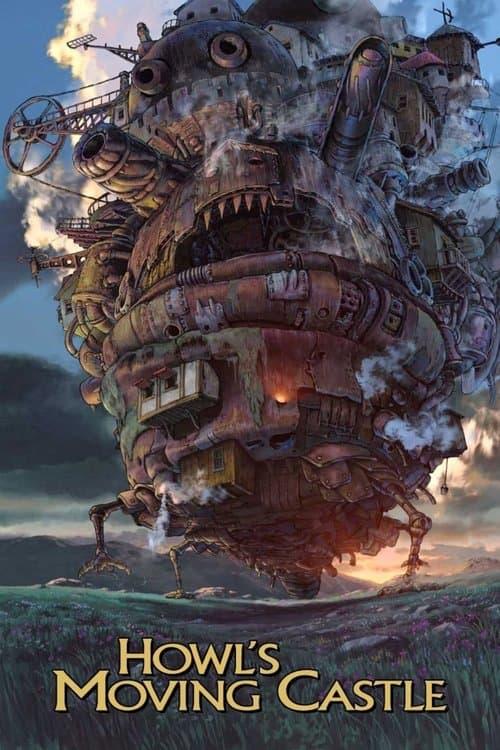
- The shifting emotional logic of the castle itself, where clutter, movement, hidden doors, and unstable spaces reflect the inner disarray of the people living inside it.
- How Miyazaki threads the antiwar material through the fantasy without separating the two, making beauty, romance, destruction, and anxiety feel like parts of the same unstable world.
- The evolving connection between Sophie, Howl, and Calcifer, especially the way love and care are expressed through cleaning, tending, protecting, and slowly uncovering what each of them has been hiding.
Production notes
Howl's Moving Castle was Hayao Miyazaki's adaptation of Diana Wynne Jones's 1986 fantasy novel, with the screenplay substantially reworked to incorporate themes about war, aging, and disfigurement that do not appear in the source. Miyazaki had become deeply concerned about the U.S. invasion of Iraq during 2003, and the film's anti-war content reflects his political reaction to that period. The moving castle itself is one of the most ambitious mechanical-design objects in any animated feature — animators developed multiple model passes for the castle's locomotion before settling on the final design. Joe Hisaishi composed the score, and the famous 'Merry-Go-Round of Life' theme has become one of the most recognized pieces of music from any Ghibli film. Chieko Baisho voiced Sophie (in both her young and aged forms), Takuya Kimura played Howl, and Akihiro Miwa voiced the Witch of the Waste. The Disney English-language dub featured Christian Bale as Howl, Lauren Bacall as the Witch of the Waste in her final completed voice role, and Jean Simmons and Emily Mortimer as Sophie.
Trivia
- Diana Wynne Jones's 1986 source novel is substantially different from Miyazaki's adaptation — the novel has no significant war content, while Miyazaki added extensive anti-war material in response to the 2003 U.S. invasion of Iraq.
- Lauren Bacall's voice work as the Witch of the Waste in the 2005 Disney English-language dub was her final completed voice role; she would die in 2014, having voiced few additional animated features after Howl's release.
- Chieko Baisho voiced Sophie at both 18 and 90 years old; her ability to perform both age ranges in a single recording session — sometimes within the same scene as Sophie's age fluctuates — became one of the most discussed casting achievements in Ghibli's history.
- Christian Bale was cast as Howl after Miyazaki personally requested an actor with romantic-leading-man qualities for the English dub; Bale's voice work has been continuously praised as one of the strongest English-language Ghibli performances.
- The film's Joe Hisaishi score — particularly the 'Merry-Go-Round of Life' main theme — has become one of the most recognized pieces of contemporary classical music in Japan, performed regularly by symphony orchestras alongside the Ghibli/Hisaishi concert programs that tour internationally.
Legacy
Howl's Moving Castle was a substantial commercial success on release, grossing approximately ¥19.6 billion at the Japanese box office (Ghibli's second-highest at the time, after Spirited Away) and performing extraordinarily well internationally. It received an Academy Award nomination for Best Animated Feature, losing to Wallace & Gromit: The Curse of the Were-Rabbit. Critically, the film received generally warm reviews, though some critics (particularly in the West) treated its plot as overstuffed compared to Spirited Away's more disciplined structure. The film's anti-war content has aged into deeper cultural relevance, and Miyazaki's explicit framing of the work as a political response to Iraq has been widely discussed in retrospective writing about the film. Joe Hisaishi's 'Merry-Go-Round of Life' score has become one of the most-performed contemporary classical pieces in Japan and a fixture of international Ghibli concert tours. Among Miyazaki's films, Howl's Moving Castle is most often cited as the most overtly romantic — and as the one whose central image (the stomping mechanical castle on chicken legs) most thoroughly embodies the studio's commitment to impossible-machine design.