Kiki's Delivery Service
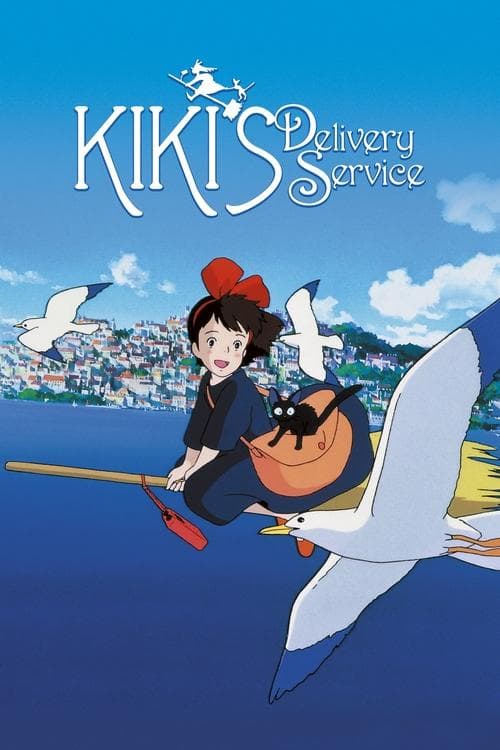
Vibe
Hayao Miyazaki’s coming-of-age fantasy follows Kiki, a young witch who leaves home for a year of independence and begins building a life for herself in a seaside city with only her broom, her black cat Jiji, and her determination to succeed. What begins as an exciting step into adulthood gradually becomes a quieter struggle with loneliness, self-doubt, and the pressure of turning talent into purpose. Miyazaki grounds the film’s magic in everyday rhythms, giving its streets, rooms, and routines a warmth that makes Kiki’s inner changes feel deeply lived-in. With its gentle humor, emotional honesty, and faith in personal growth, Kiki’s Delivery Service becomes a story about confidence, burnout, and learning how to find yourself again when your sense of self begins to fade.
Watch for
- The way Kiki’s early excitement gradually gives way to loneliness and self-doubt, turning a magical independence story into something more emotionally recognizable and human.
- How Miyazaki uses the city itself—its rooftops, streets, bakeries, and crowded routines—to mirror Kiki’s shifting confidence as she tries to build a place for herself.
- Jiji’s role in the film, especially how his presence changes as Kiki’s inner life changes, making him feel closely tied to her sense of ease, imagination, and emotional balance.
- The film’s quiet pauses and everyday details, which make Kiki’s burnout feel earned and help the story find drama not in villains or danger, but in the fragile process of regaining belief in yourself.
Production notes
Kiki's Delivery Service was Hayao Miyazaki's adaptation of Eiko Kadono's 1985 children's novel — and the film whose commercial success would establish Studio Ghibli as a profitable, sustainable studio rather than a precarious art-cinema venture. Miyazaki took over directing from the originally attached Sunao Katabuchi midway through development, eventually rewriting the screenplay almost entirely. The film's Mediterranean-coastal setting was inspired by research trips to Stockholm, Visby, and Adelaide; Ghibli built up extensive reference photography of European port cities to shape the look of Koriko, Kiki's adopted home. Joe Hisaishi composed the score. Minami Takayama voiced both Kiki and Ursula, while Rei Sakuma played Jiji. The Disney English-language dub featured Kirsten Dunst as Kiki and Phil Hartman in his final voice role as Jiji before his death in May 1998 — the dub was completed shortly before Hartman's murder. The film took approximately one year to animate.
Trivia
- Kiki's Delivery Service was the first Ghibli film to participate in significant commercial cross-promotion — Yamato Transport, the Japanese delivery company whose logo features a black cat carrying a kitten, partnered with Ghibli throughout the film's marketing.
- Phil Hartman's voice work as Jiji in the 1998 Disney English dub was his final completed role; Hartman was murdered in May 1998 while the dub was in post-production, and the film became one of his last broadcast performances.
- Kiki's depression in the second half of the film — her temporary loss of the ability to fly and to understand Jiji — was Miyazaki's deliberate attempt to honestly depict creative burnout and the loss of self-confidence young women experience in early adulthood.
- Eiko Kadono, the source novel's author, was reportedly unhappy with Miyazaki's substantial reworking of her plot — particularly the addition of the climactic airship rescue scene — and the relationship between the studio and Kadono required diplomatic mediation by Toshio Suzuki to repair.
- The film grossed approximately ¥4.3 billion at the Japanese box office, becoming the highest-grossing Japanese film of 1989 and establishing Studio Ghibli as commercially viable beyond just critical respect.
Legacy
Kiki's Delivery Service was the financial breakthrough that cemented Studio Ghibli as a sustainable studio — its Japanese box office of approximately ¥4.3 billion made it 1989's highest-grossing domestic film and proved that Miyazaki's authorial sensibility could deliver mainstream commercial results. The film's depiction of a young woman starting her adult life in a new city has resonated across generations of viewers, and Kiki's brief depression — her temporary loss of magical ability — has become one of the most-cited examples of mainstream animation honestly depicting creative burnout. The Yamato Transport delivery-company partnership established a model for Ghibli's commercial collaborations that the studio has continued more selectively since. Among Miyazaki's films, Kiki is often cited as the most accessible entry point for new viewers — particularly young women — and as the most thoroughgoing portrait of independence, work, and finding oneself outside one's family. Kiki, like Totoro, became one of Ghibli's permanent character icons, with extensive merchandising and theme-park presence.