My Neighbor Totoro
Vibe
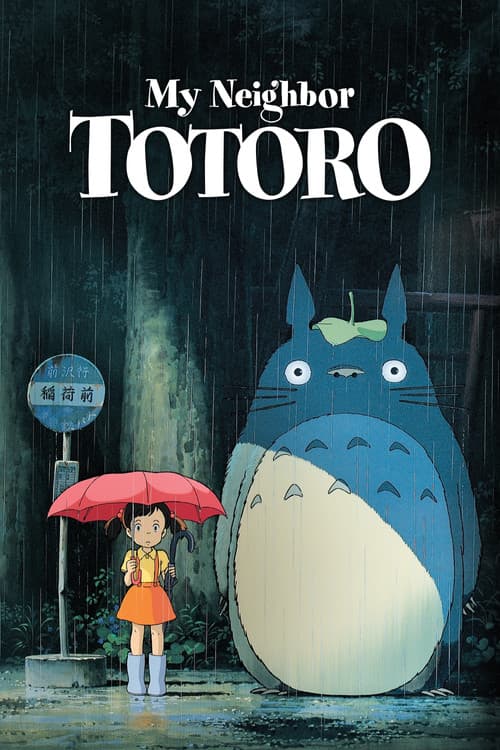
Hayao Miyazaki’s gentle fantasy follows sisters Satsuki and Mei as they move with their father to the countryside and discover a world of spirits, soot sprites, and the mysterious forest creature Totoro. Set against the uncertainty of their mother’s illness, the film transforms ordinary rural life into something magical, where wonder emerges not from spectacle but from a child’s openness to the unseen. Miyazaki fills the story with quiet observation, seasonal beauty, and a deep sense of comfort rooted in home, nature, and family. With its softness, warmth, and enduring imagination, My Neighbor Totoro becomes a story about childhood, resilience, and the healing power of wonder.
Watch for
- How Miyazaki turns the countryside into a place of everyday wonder, where rustling trees, creaking houses, and sudden discoveries make the natural world feel alive without forcing fantasy into spectacle.
- The changing emotional dynamic between Satsuki and Mei, especially as playfulness and curiosity begin to coexist with anxiety over their mother’s illness.
- The famous bus stop sequence, where stillness, rain, and simple gestures create one of the film’s most memorable expressions of comfort, mystery, and childhood awe.
- How Totoro functions less as a conventional character than as an embodiment of shelter, imagination, and the strange reassurance children sometimes find in the unknown.
Production notes
My Neighbor Totoro was the second of the two films released as Studio Ghibli's April 1988 double feature alongside Grave of the Fireflies. Hayao Miyazaki developed the project from his own childhood memories of post-war rural Japan — the film is set in 1958 in the Saitama countryside — and from his concerns about his late mother, whose long illness with spinal tuberculosis directly informed Mei and Satsuki's hospitalized mother. The film required substantial visual development to achieve its specific atmospheric quality, and the team produced extensive landscape studies of the Sayama Hills west of Tokyo. The double-feature pairing meant that Miyazaki's gentle children's film was running on the same screens as Takahata's wartime tragedy — a structural decision that initially puzzled Japanese audiences. Joe Hisaishi composed the score. Noriko Hidaka voiced Satsuki and Chika Sakamoto played Mei, with Hitoshi Takagi as Totoro himself.
Trivia
- Totoro's design was based partly on a tanuki, partly on an owl, and partly on a cat — Miyazaki has said the character is none of those animals specifically but rather an entirely original forest spirit.
- The film is set in 1958 — Miyazaki's own childhood era — and in the Sayama Hills west of Tokyo; the area was undergoing rapid suburbanization during the film's late-1980s production, lending the work an additional layer of nostalgia for a vanishing landscape.
- Mei and Satsuki's mother's illness was directly inspired by Miyazaki's own mother, who had spinal tuberculosis throughout his childhood; she would survive into Hayao's adulthood, but the experience of her hospitalization shaped his lifelong storytelling.
- Totoro became Studio Ghibli's official mascot and corporate logo; the image of the standing Totoro under the Ghibli logo appears at the start of nearly every Ghibli film released since.
- The fan theory that Totoro is a god of death and that Mei dies during the film has been formally and repeatedly denied by Studio Ghibli, with the studio publishing official disavowals on its website to address the persistent online reading.
Legacy
My Neighbor Totoro has become Studio Ghibli's signature work and one of the most beloved children's films ever made — the title that introduces most Western viewers to the studio and the source of Ghibli's permanent corporate mascot. The film's commercial trajectory at release was modest, but its merchandising afterlife has been extraordinary: Totoro plush toys, household goods, and licensed products generate massive ongoing revenue, and the character's image is now one of the most recognizable in global animation. Akira Kurosawa included the film on his list of his hundred favorite films of all time. The film entered the U.S. Library of Congress National Film Registry in 2018, the first non-American animated feature to receive that honor. The Royal Shakespeare Company adapted Totoro for the London stage in 2022, an extraordinary cross-cultural translation of Japanese children's animation into prestige theater. Among Ghibli's films, My Neighbor Totoro is the one most thoroughly woven into childhood iconography across multiple cultures.