My Neighbors the Yamadas
Vibe
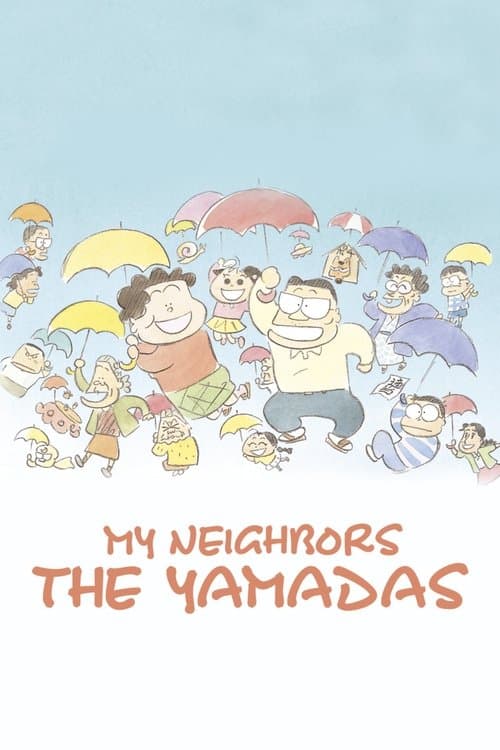
Isao Takahata’s loose, comic family portrait follows the everyday lives of the Yamada household, turning small domestic mishaps, marital squabbles, childhood misunderstandings, and generational tensions into a series of humorous and quietly perceptive vignettes. Rather than building toward a single dramatic arc, the film finds its meaning in accumulation, revealing how family life is shaped less by grand events than by habits, frustrations, affection, and the constant negotiation of living together. Its watercolor-inspired visual style gives the film an airy, sketchbook spontaneity that matches its observational tone and gentle wit. With its warmth, humor, and clear-eyed affection for imperfection, My Neighbors the Yamadas becomes a story about ordinary family life and the small moments that make it both exhausting and deeply human.
Watch for
- How Takahata finds humor in timing, repetition, and tiny domestic frictions, turning routine family annoyances into something both comic and sharply recognizable.
- The watercolor sketch style, which gives the film an airy spontaneity and allows emotion, exaggeration, and everyday messiness to feel loose and alive rather than overly polished.
- The way individual vignettes build on one another, gradually revealing the rhythms of a family whose affection is expressed as often through irritation and habit as through tenderness.
- How the film treats ordinary life as worthy of close observation, making missed trains, family meals, shopping trips, and awkward conversations feel like the real substance of living together.
Production notes
My Neighbors the Yamadas was Isao Takahata's most stylistically experimental Studio Ghibli feature — a loose adaptation of Hisaichi Ishii's four-panel newspaper comic strip Nono-chan, animated in a deliberately rough watercolor-and-pencil style designed to mimic the look of newspaper cartoons. The film was Studio Ghibli's first production made entirely with digital animation and digital compositing, requiring the team to develop new techniques for replicating hand-drawn imperfection in digital form — a technically demanding inverse of the typical animation problem. Takahata structured the film as a series of comic vignettes about ordinary suburban family life, with no overarching plot. Yukiji Asaoka voiced the matriarch Matsuko, with Toru Masuoka as the father Takashi. Composer Akiko Yano scored the film. The production cost was reportedly higher than the studio's naturalistic features — the watercolor look required substantial digital experimentation — and the film's commercial reception in Japan was disappointing relative to Princess Mononoke's just-prior blockbuster success.
Trivia
- My Neighbors the Yamadas was Studio Ghibli's first feature animated entirely with digital techniques; the deliberately rough watercolor-and-pencil look required the team to develop new tools for replicating hand-drawn imperfection in digital form.
- The film adapts Hisaichi Ishii's four-panel newspaper comic strip Nono-chan, which had been running in Asahi Shimbun since 1991; the comic-strip origin shaped the film's vignette-based structure.
- Despite its modest narrative ambitions, the film was reportedly one of Studio Ghibli's most expensive productions to date — the digital tools needed to make CGI look hand-drawn were costly to develop, and the production required substantial experimentation.
- The film grossed only ¥1.55 billion at the Japanese box office — a substantial commercial disappointment after Princess Mononoke's just-prior record-breaking ¥20.18 billion run, and a result that reportedly contributed to internal Ghibli debate about Takahata's preferred stylistic experimentation.
- Yamadas was distributed in North America by Disney as part of its Ghibli deal, but received only a limited theatrical run; it has become one of the harder-to-find Ghibli features in the West and is not as widely-discussed as the studio's better-known works.
Legacy
My Neighbors the Yamadas occupies a unique stylistic position in the Studio Ghibli catalog — its watercolor-and-pencil look is unlike any other Ghibli film, and its loose vignette structure with no overarching plot is unusual for any feature animation. Its commercial reception was modest (approximately ¥1.55 billion at the Japanese box office, after Princess Mononoke's blockbuster ¥20.18 billion just two years earlier), and the film has remained one of the harder-to-find Ghibli titles in Western distribution. Critically, however, it has aged into significant respect among writers interested in animation as visual art rather than as narrative medium — the film's deliberate refusal of conventional storytelling and its commitment to a hand-drawn-imperfect digital aesthetic remain genuinely unusual in mainstream animation. Among Takahata's films, Yamadas is the most thoroughgoing experiment in what animation can look like and what it can be about — an experiment that Takahata would extend in his final feature, The Tale of the Princess Kaguya.