Ocean Waves
Vibe
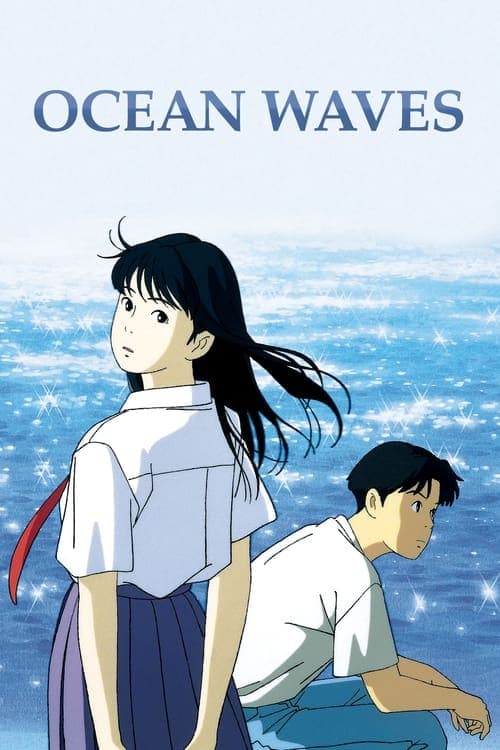
Tomomi Mochizuki’s understated coming-of-age drama follows Taku, a high school student in Kochi whose quiet routine is unsettled by the arrival of Rikako, a brilliant but aloof transfer student whose presence complicates his friendships and emotional life. What begins as a familiar portrait of adolescence gradually reveals itself as something more awkward, uncertain, and unresolved, capturing the confusion of young feelings that are often stronger than anyone involved knows how to express. The film’s restrained tone and everyday settings give it a realism unusual even within the Ghibli catalog, favoring fleeting gestures and half-understood emotions over tidy catharsis. With its melancholy mood and emotional ambiguity, Ocean Waves becomes a story about youth, distance, and the lingering ache of connections that make sense only in retrospect.
Watch for
- The understated tension between Taku, Rikako, and Yutaka, where small gestures, pauses, and misunderstandings carry more weight than overt declarations ever do.
- How the film uses ordinary settings—classrooms, train stations, hotel rooms, city streets—to ground its emotional uncertainty in a recognizably lived teenage world.
- The way Rikako is presented as both magnetic and difficult to understand, making the film less about idealized romance than about the confusion of being drawn to someone you cannot fully read.
- How the story’s emotional meaning only fully settles in retrospect, capturing the strange truth that some adolescent experiences become clearer only after they are already gone.
Production notes
Ocean Waves was directed by Tomomi Mochizuki and produced for television rather than theatrical release — a deliberate move by Studio Ghibli leadership to give the studio's younger animators (most in their twenties) a feature-scale project on a smaller budget than the studio's typical theatrical productions. The intention was to develop new directing talent at lower financial risk. Saeko Himuro wrote the original 1990 novel; Kaori Nakamura adapted it. Mochizuki had been a story artist on earlier Ghibli features and was making his Ghibli directorial debut. The film's Tokyo and Kochi settings drew on the source novel's specific geography. Nobuo Tobita voiced Taku, Toshihiko Seki played Yutaka, and Yoko Sakamoto was Rikako. Composer Shigeru Nagata scored the film. The production famously went over budget and over schedule despite its small-team intentions, partly because Mochizuki was new to feature-length work — an experience that informed Ghibli's subsequent approach to developing junior directors.
Trivia
- Ocean Waves was Studio Ghibli's first made-for-television feature, originally broadcast on Nippon TV in May 1993 rather than receiving theatrical release; it was conceived as a way to develop younger animators on a smaller budget.
- The film was directed by Tomomi Mochizuki, who at the time of production was 35 — making him at the time the youngest director to helm a Ghibli feature, and the only major Ghibli feature not directed by Miyazaki, Takahata, or one of their direct successors.
- Despite the original intention to keep production cheap and on-schedule, Ocean Waves famously went substantially over budget and over its planned schedule — an experience that reportedly informed Studio Ghibli's later, more cautious approach to mentoring junior directors.
- The film received a U.S. theatrical release through GKIDS in 2016 — twenty-three years after its Japanese television premiere — and the new English-language version included voice work by future stars from American animation circles.
- Ocean Waves is one of the few Studio Ghibli features that does not feature a Joe Hisaishi score; composer Shigeru Nagata's quieter, more pop-oriented soundtrack reflects the film's TV-movie origins and modest production scale.
Legacy
Ocean Waves has long been considered the 'minor' entry in the Studio Ghibli catalog — the small TV-movie that the studio's leadership reportedly avoided promoting alongside its theatrical features. Its 2016 U.S. theatrical release through GKIDS gave it a formal Western coming-out 23 years after its Japanese debut, and many Western viewers have discovered it only through that delayed release. The film's restrained, pop-influenced sensibility and its straightforward teenage-romance plot mark it as a clear outlier from the typical Ghibli template — no fantasy, no morally complex adult themes, no fable structure — and that very modesty has earned it a devoted secondary following among viewers looking for the studio's quieter side. Among Ghibli's catalog, Ocean Waves is the most thoroughly small-scale work, and the one that most clearly prefigures the contemporary-realism films (Whisper of the Heart, From Up on Poppy Hill) that the studio would produce in subsequent years.