Only Yesterday
Vibe
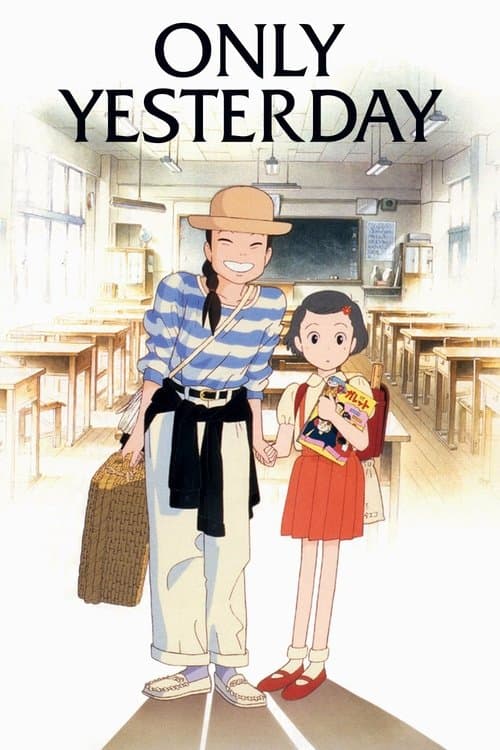
Isao Takahata’s reflective drama follows Taeko, a twenty-seven-year-old woman from Tokyo who travels to the countryside and finds herself revisiting memories of her fifth-grade self with unexpected clarity. As past and present begin to intermingle, the film turns small childhood moments—classroom embarrassments, family tensions, early longings—into pieces of a larger emotional portrait about the person she has become and the life she still wants. Takahata’s understated direction gives the film a rare intimacy, allowing memory to feel fluid, imperfect, and quietly revealing rather than nostalgic in a simple way. With its emotional precision and mature perspective, Only Yesterday becomes a story about memory, adulthood, and the difficult, beautiful process of recognizing who you have been in order to understand who you are.
Watch for
- How Takahata moves between Taeko’s adult life and her childhood memories, allowing the past to feel less like flashback than an active, unfinished part of who she still is.
- The subtle emotional weight given to ordinary moments—school embarrassments, family conversations, small disappointments—which gradually accumulate into a much deeper portrait of adulthood and self-understanding.
- The visual distinction between past and present, especially the softness and openness of the remembered scenes, which makes memory feel selective, intimate, and emotionally alive.
- How the film resists obvious dramatic turns, instead revealing its meaning through reflection, hesitation, and the slow realization that the person you were as a child may still be quietly shaping the life you choose.
Production notes
Only Yesterday was Isao Takahata's first feature after Grave of the Fireflies and represented the studio's first explicitly adult-targeted animated drama — a film about a 27-year-old Tokyo office worker reflecting on her childhood self, with no fantasy elements at all. Takahata adapted Hotaru Okamoto and Yuko Tone's manga, expanding it substantially with the present-day adult narrative that frames the childhood flashbacks. The film's two visual registers — naturalistic, watercolor-soft present-day scenes and more cartoonish, paper-textured childhood flashbacks — required developing two distinct animation pipelines. Miki Imai voiced the adult Taeko, with Toshirō Yanagiba as Toshio. The film's depiction of a menstruation conversation among schoolgirls became one of the most discussed scenes in early Ghibli animation, and may have contributed to the film's lengthy delay in Disney-distributed Western release. GKIDS finally released the film theatrically in North America in 2016 — twenty-five years after its Japanese premiere — with Daisy Ridley voicing the adult Taeko.
Trivia
- Only Yesterday was Studio Ghibli's first explicitly adult-targeted feature, with no fantasy elements and a 27-year-old female office worker as protagonist; this thematic choice was extraordinary for animated cinema in 1991, and remains so for Ghibli's catalog.
- The film features one of the first frank depictions of menstruation conversation in any animated feature; the schoolgirl scene where the topic is discussed has been credited as a contributing factor to the film's 25-year delay in Western theatrical release.
- GKIDS finally distributed Only Yesterday in North America in February 2016 — twenty-five years after its 1991 Japanese release — with Daisy Ridley (fresh from Star Wars: The Force Awakens) voicing the adult Taeko in the new English dub.
- The film's two visual registers — soft-focus naturalistic present-day scenes and brighter paper-textured childhood flashbacks — required Ghibli's animators to develop two distinct stylistic approaches running simultaneously through the film.
- Takahata's research for the rural farming scenes included extended visits to Yamagata prefecture, where the film's safflower-harvesting sequences are set; the depiction of agricultural labor was unusual for animated cinema and reflects Takahata's lifelong interest in rural Japanese life.
Legacy
Only Yesterday occupies a unique position in the Ghibli catalog — the studio's most resolutely adult, most narratively grounded, most stylistically restrained film, with no fantasy elements at all. Its 25-year delay in Western theatrical release until GKIDS's 2016 distribution made it essentially a fresh discovery for a generation of Western Ghibli enthusiasts who had grown up with the studio's better-known fantasies. Critical reception of the 2016 release was extraordinarily warm, with many critics treating the film as a major rediscovery. Among Takahata's films, Only Yesterday is the most often cited as proof that Ghibli's animation tradition can support fully adult dramatic material without fantasy or fable — a quality that has anchored its enduring reputation among film critics. The film entered the official rankings of greatest animated films of all time in multiple international polls following its delayed Western release, and continues to be championed by writers focused on women's narratives in animation.