Pom Poko
Vibe
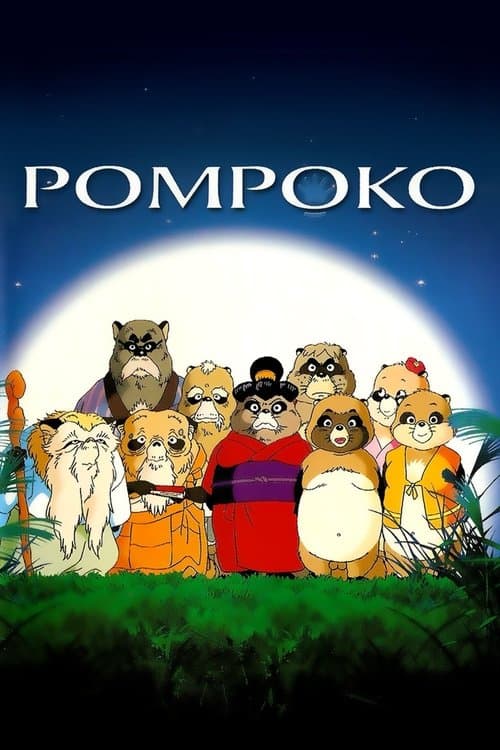
Isao Takahata’s wild and mournful environmental fable follows a community of tanuki whose forest home is threatened by rapid suburban development, forcing them to unite, adapt, and fight for survival as the human world closes in around them. Shifting between slapstick comedy, folklore, and tragedy, the film uses the tanuki’s shapeshifting abilities not just for spectacle but as a reflection of desperation, resilience, and cultural memory under pressure. Takahata embraces tonal extremes, allowing the story to feel playful, absurd, angry, and heartbreaking all at once as its world becomes steadily smaller. With its chaotic energy and deep sorrow, Pom Poko becomes a story about displacement, modernity, and the painful cost of progress when it severs people and creatures from the land that sustained them.
Watch for
- How Takahata lets slapstick absurdity and looming sadness exist side by side, allowing the tanuki’s comic energy to gradually give way to a deeper feeling of desperation and loss.
- The shapeshifting sequences, which are not only visually inventive but also expressive of cultural memory, communal identity, and the frantic creativity of a people trying to survive erasure.
- The way modern development is shown not as a single villainous act but as a steady, overwhelming force that shrinks the tanuki world piece by piece until resistance itself begins to feel exhausting.
- How the film’s emotional power comes from accumulation, as jokes, rituals, failed plans, and fleeting victories slowly build into a mournful portrait of a community watching its home disappear.
Production notes
Pom Poko was Isao Takahata's third Studio Ghibli feature and one of the most ambitious — a two-hour-twenty-minute fable about a community of tanuki (Japanese raccoon dogs) struggling to defend their forest home from suburban development in 1960s and 1970s Tokyo. The film fuses documentary realism with extensive folkloric reference: tanuki in Japanese tradition are shapeshifters, and the film draws on hundreds of years of folk tales about their transformations. Hayao Miyazaki served as executive producer. The production required animators to develop multiple tanuki visual styles — naturalistic, anthropomorphic-cartoonish, and traditional ukiyo-e — that coexist within the same film. Shincho Kokontei voiced the narrator; the cast included rakugo performers and traditional Japanese voice actors. The film took approximately two years to animate. Miyazaki himself has reportedly cited Pom Poko as one of his personal favorites among Takahata's films.
Trivia
- Pom Poko's title comes from the rhythmic sound made by tanuki drumming on their bellies — a folk-traditional Japanese onomatopoeia that the film treats as both literal and metaphorical.
- Tanuki in Japanese folklore are renowned for their oversized scrota (which the film depicts unflinchingly in multiple scenes), and the U.S. dub by Disney required substantial euphemism — the testicles are translated as 'pouches' throughout, a translation choice that has become a frequently-discussed example of cultural translation difficulty.
- The film features an extended dance-of-spirits sequence in which the tanuki summon hundreds of yokai (Japanese ghost creatures) in a final desperate attempt to scare humans away; the sequence is a tour de force of folk-tradition reference and contains over a hundred distinct yokai designs.
- Pom Poko addresses the very real Tama New Town development in western Tokyo — a planned community whose construction in the 1960s and 1970s genuinely displaced significant local wildlife populations.
- The film's central message — that ecological loss is irreversible and that resistance is often futile — gives it a darker emotional ending than typical environmental fables; the surviving tanuki must choose whether to disguise themselves as humans or live as ordinary forest animals.
Legacy
Pom Poko's commercial reception in Japan was strong — it was the highest-grossing Japanese film of 1994 — but its international reputation has been complicated by the difficulty of translating its specifically Japanese folkloric content. The film grossed approximately ¥4.5 billion at the Japanese box office. Critically, the film has aged into significant respect, particularly among writers interested in environmental storytelling and indigenous Japanese folklore in mainstream cinema. The tanuki-shapeshifter tradition the film preserves and celebrates has been continuously discussed in academic contexts since release. Among Takahata's films, Pom Poko is the one most thoroughly engaged with traditional Japanese folkloric content, and the one that most insists on the cultural specificity of its source material rather than reaching for universal allegory. The film's ending — the tanuki choosing assimilation or surrender — has been read as one of the saddest and most resigned conclusions in any Ghibli feature.