Ponyo
Vibe
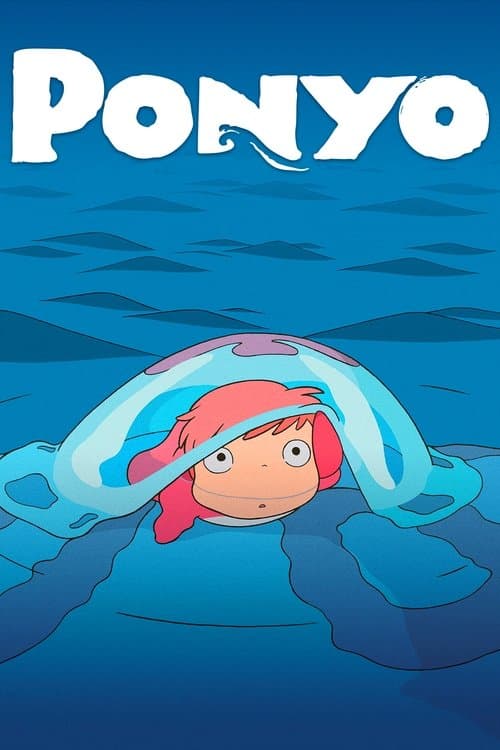
Hayao Miyazaki’s exuberant fantasy follows Sosuke, a young boy living by the sea, and Ponyo, a goldfish-like creature who longs to become human after a chance encounter binds their fates together. What begins as a childlike friendship soon ripples outward into a magical upheaval that blurs the boundaries between ocean and land, innocence and responsibility, play and peril. Miyazaki fills the film with fluid movement, bright color, and a sense of elemental joy, turning waves, storms, and small domestic spaces into part of a living fairy tale. With its warmth, wonder, and deep affection for childhood imagination, Ponyo becomes a story about love, transformation, and the fragile harmony between human life and the natural world.
Watch for
- How Miyazaki animates the sea as a living, emotional force, with waves, currents, and underwater motion carrying as much personality and expressive energy as the film’s characters.
- The directness of Ponyo and Sosuke’s bond, which gives the story its emotional center and allows the film’s larger magical upheavals to feel rooted in childhood trust rather than abstract fantasy rules.
- The visual shift that occurs once the ocean begins overtaking the human world, turning familiar roads, houses, and boats into part of a playful but faintly uncanny fairy-tale landscape.
- How the film keeps returning to small acts of care—food, shelter, promises, and simple reassurance—so that its grander themes of transformation and balance stay grounded in the emotional world of children.
Production notes
Ponyo was Hayao Miyazaki's deliberate return to a children's-film register after the more adult ambitions of Howl's Moving Castle. The film loosely adapts Hans Christian Andersen's 'The Little Mermaid' but locates the story on the rocky Japanese coast at Tomonoura, which Miyazaki had visited and found deeply inspiring. The film features approximately 170,000 individual drawings — one of the highest-frame-count animated features ever produced — and Miyazaki insisted that the film be almost entirely hand-drawn, with minimal computer-generated imagery. The water and ocean sequences in particular required extensive technical development; Miyazaki personally supervised the wave animations. Joe Hisaishi composed the score, and the catchy theme song 'Ponyo on the Cliff by the Sea' performed by Yuria Mori became a children's-music phenomenon in Japan. Yuria Nara voiced Ponyo and Hiroki Doi played Sosuke. The Disney English-language dub featured Noah Cyrus, Frankie Jonas, Tina Fey, Liam Neeson, Cate Blanchett, and Matt Damon.
Trivia
- Ponyo features approximately 170,000 individual drawings — one of the highest-frame-count animated features ever produced — and Miyazaki insisted on minimal use of CGI, returning to almost entirely hand-drawn animation after the partially-digital Howl's Moving Castle.
- The film's setting is based directly on Tomonoura, a small fishing harbor on Japan's Inland Sea where Miyazaki had spent two months in residence during early development; the village's specific architecture and harbor geometry inform every shot.
- The Disney English-language dub featured Frankie Jonas (younger brother of the Jonas Brothers) as Sosuke, in his only feature voice acting role to date; the casting was a deliberate strategy to attract young Disney Channel audiences to the film.
- Composer Joe Hisaishi's son Mai Fujisawa performed the original Japanese end-credits song 'Ponyo on the Cliff by the Sea' (alongside Yuria Mori), one of the few times Hisaishi has involved his family in a Ghibli production.
- The film's wave animations — particularly the climactic giant tsunami sequence — were personally supervised by Miyazaki, who reportedly drew over 1,600 of the wave-related frames himself.
Legacy
Ponyo became one of Studio Ghibli's most commercially successful releases, grossing approximately ¥15.5 billion at the Japanese box office and performing well internationally despite its more explicitly children's-film register. It received an Academy Award nomination for Best Animated Feature. The film has become one of the more popular Ghibli entry points for very young viewers, and its catchy theme song became a children's-music phenomenon in Japan that remains widely sung decades after release. Among Miyazaki's films, Ponyo is the most thoroughgoingly child-targeted — a film whose emotional and narrative complexity is calibrated for primary-school audiences in ways the studio's other features are not. Critics have generally found it slighter than Miyazaki's adult works while celebrating the extraordinary craftsmanship of its hand-drawn animation. The film's near-elimination of computer-generated imagery, in an era when even Ghibli was steadily increasing CGI use, has been continuously cited by traditional-animation enthusiasts as a major artistic statement.