Porco Rosso
Vibe
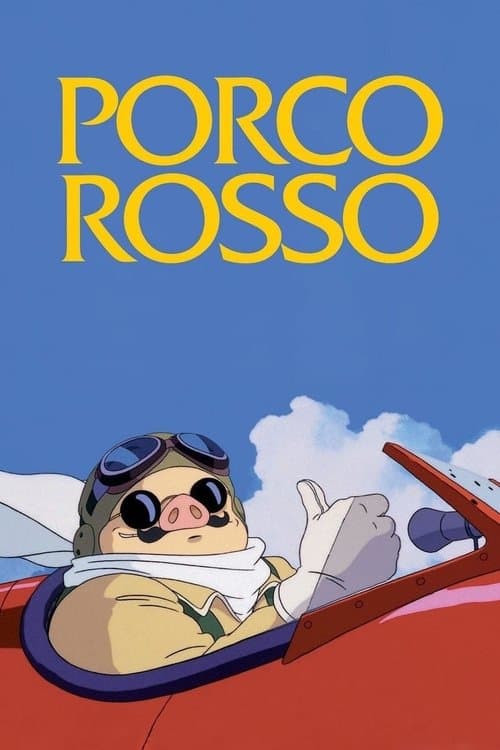
Hayao Miyazaki’s romantic adventure follows Porco, a World War I flying ace turned bounty hunter who has been transformed into a pig and now drifts through the Adriatic skies with equal parts cynicism, skill, and wounded pride. When a brash American pilot challenges his reputation and old loyalties begin resurfacing, Porco is forced to confront the ideals, losses, and compromises that shaped the man he once was. The film blends aerial spectacle, dry wit, and melancholy with a lived-in sense of place, turning seaplanes, island hideouts, and smoky lounges into part of its emotional texture. With its mixture of charm and disillusionment, Porco Rosso becomes a story about freedom, memory, and the stubborn dignity of holding onto your humanity in a broken world.
Watch for
- How Miyazaki stages the aerial sequences with a mix of exhilaration and melancholy, making flight feel not just adventurous but tied to memory, freedom, and the remnants of a fading world.
- Porco’s interactions with Fio and Gina, which gradually reveal the tenderness, regret, and emotional weariness beneath his cynicism and comic bravado.
- The film’s balance of glamour and disillusionment, especially in the way seaplanes, island hideouts, and Adriatic vistas are made to feel both romantic and haunted by history.
- How the story turns a bizarre premise into something deeply human, using Porco’s curse less as fantasy gimmick than as an outward reflection of shame, resistance, and wounded identity.
Production notes
Porco Rosso began as a short manga serial Hayao Miyazaki had drawn for Model Graphix magazine in 1989 — a series of brief comic stories about a World War I flying ace turned bounty hunter who has been cursed into the form of a pig. The film expands the manga substantially, weaving in the Italian Adriatic setting, the rise of Italian fascism in the early 1930s, and Marco's romantic history with Madame Gina. Miyazaki took an extended research trip to the Croatian and Italian Adriatic coast during development. The film was originally conceived as a Japan Airlines in-flight short before Toshio Suzuki convinced Miyazaki to expand it to feature length. Joe Hisaishi composed the score, with Tokiko Kato performing Gina's haunting nightclub song 'Le Temps des Cerises.' Shuichirō Moriyama voiced Porco. The Disney English-language dub featured Michael Keaton as Porco, with Susan Egan as Gina and Cary Elwes as Curtis. Production took approximately fifteen months.
Trivia
- Porco Rosso was originally conceived as a short in-flight film for Japan Airlines; producer Toshio Suzuki convinced Miyazaki to expand it to feature length, and JAL still maintained a partnership with the production through development.
- The protagonist's curse — a World War I flying ace transformed into a pig — was Miyazaki's explicit metaphor for political disillusionment and the moral compromises of survival in fascist Italy; he has said the film is more politically engaged than American audiences typically read it.
- Marco's nightclub song 'Le Temps des Cerises' is a real 1866 French chanson associated with the Paris Commune; its inclusion in a 1992 Japanese animated film about Italian aviation was a deeply specific cultural quotation few non-French viewers caught at release.
- Miyazaki's lifelong aviation obsession reaches full expression in Porco Rosso — the film's flight sequences are some of the most lovingly detailed aircraft animation in any feature, and the seaplanes are based on real-world Macchi and Savoia designs from the 1920s and 1930s.
- Madame Gina's hotel was directly modeled on the Hotel Adriatic in Rovinj, Croatia; Miyazaki's research trip to the Adriatic coast informed essentially every visual detail of the film's Mediterranean setting.
Legacy
Porco Rosso has aged into one of Miyazaki's most beloved films — particularly among adult viewers who appreciate its noir-inflected melancholy, its political seriousness, and its romance between two characters who are clearly past the optimism of youth. The film grossed approximately ¥2.85 billion at the Japanese box office and was a substantial commercial success at release. Its critical reputation has grown over decades, and it now appears regularly on lists of the greatest animated films ever made. Among Miyazaki's films, Porco Rosso is the one most explicitly engaged with the moral complexity of being an adult — the curse, the political compromises, the romantic regrets — and the one that has been most often described as 'his autobiography in disguise.' The film's seaplane designs and Adriatic-coast aesthetic have continued to inspire animators, illustrators, and aviation-history enthusiasts. Miyazaki has periodically discussed making a sequel, with the tentative title Porco Rosso: The Last Sortie set during the Spanish Civil War, but no production has materialized.