Princess Mononoke
Vibe
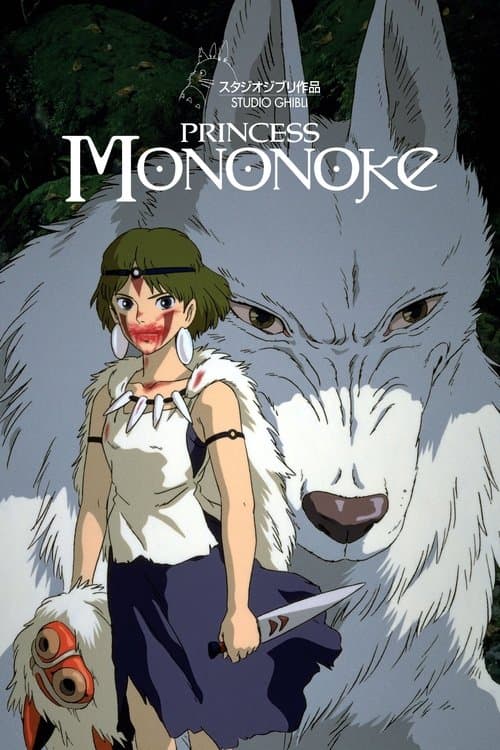
Hayao Miyazaki’s epic fantasy follows Ashitaka, a young prince cursed after defending his village from a demonic boar god, who travels west in search of a cure and finds himself caught between the forces of industry and the spirits of the forest. As he encounters Lady Eboshi’s ironworks and the fierce, wolf-raised San, the film refuses simple heroes or villains, instead framing its conflict as a clash of survival, progress, vengeance, and belief. Miyazaki gives the world a mythic scale without losing sight of its human and spiritual complexity, filling the story with unforgettable landscapes, creatures, and moments of violence and grace. With its moral depth and elemental power, Princess Mononoke becomes a story about conflict, coexistence, and the painful search for balance in a world shaped by both destruction and need.
Watch for
- How Miyazaki frames Iron Town and the forest gods with equal conviction, refusing to reduce either side of the conflict to simple good or evil.
- The physical intensity of the action, where arrows, curses, blood, and animal force give the film a rawness that makes its mythic world feel dangerously alive.
- Ashitaka’s role as observer and participant, especially the way his calm presence allows the film to move through rage, grief, and competing truths without settling for easy judgment.
- How the great spirit creatures are introduced and filmed, shifting the story from fantasy adventure into something stranger and more sacred, where the natural world feels immense, beautiful, and unstable.
Production notes
Princess Mononoke was Hayao Miyazaki's most ambitious project to date — a two-hour-thirteen-minute epic that took approximately three years to animate and required Miyazaki's personal supervision of every key shot. The film's setting in the Muromachi period (14th-16th century Japan) required extensive historical research, with the team developing detailed visual references for medieval ironworks, gun manufacturing, and Emishi tribal culture. The film features over 144,000 individual drawings and was one of the first Studio Ghibli features to make significant use of computer-generated imagery alongside traditional hand-drawn animation. Joe Hisaishi composed the score. Yōji Matsuda voiced Ashitaka, Yuriko Ishida played San, and the cast included Akihiro Miwa as Moro the wolf goddess and Hisaya Morishige as the hugely respected Lady Eboshi. The 1999 Disney English-language dub by Neil Gaiman featured Billy Crudup, Claire Danes, Minnie Driver, Billy Bob Thornton, and Gillian Anderson. The film cost approximately ¥2.35 billion to produce.
Trivia
- Princess Mononoke became the highest-grossing Japanese film of all time on its release in 1997, surpassing E.T. the Extra-Terrestrial; it held that record until Titanic surpassed it in early 1998 — but it remained Studio Ghibli's most commercially significant film until Spirited Away.
- The English-language dub script was written by author Neil Gaiman, who was a young novelist at the time; the Miramax executives reportedly demanded substantial cuts that Toshio Suzuki famously rejected by sending Harvey Weinstein a samurai sword with a note reading 'No cuts,' contributing to Disney's eventual no-cuts policy for Ghibli films.
- The film's English-language voice cast included Billy Bob Thornton (the monk Jigo), Claire Danes (San), Billy Crudup (Ashitaka), Minnie Driver (Lady Eboshi), and Gillian Anderson (Moro the wolf goddess) — one of the most distinguished dub casts in any animated feature.
- Miyazaki personally supervised every key shot in the film and is reported to have hand-corrected approximately 80,000 of the film's 144,000 individual drawings — an unprecedented level of directorial intervention even by Ghibli standards.
- A 2024 4K theatrical re-release in North America became one of the highest-grossing animated re-releases in U.S. box-office history, suggesting the film's audience has continued to grow rather than diminish over its quarter-century life.
Legacy
Princess Mononoke's release in July 1997 was a watershed moment for Japanese animation — its Japanese box office of approximately ¥20.18 billion made it the highest-grossing domestic film in Japanese history, surpassing E.T., and held that record until early 1998. It was also the film whose 1999 Miramax-distributed English release first introduced Hayao Miyazaki to a substantial American audience, with Neil Gaiman's celebrated dub script. The 'No cuts' samurai-sword episode between Toshio Suzuki and Harvey Weinstein has become one of the most-told anecdotes in international film distribution history. Princess Mononoke's environmental themes — the impossibility of a clean victory between human civilization and the natural world — have aged into deeper resonance as climate concerns have grown. The film's 2024 4K theatrical re-release performed extraordinarily well domestically, confirming its expanding audience. Among Miyazaki's films, Princess Mononoke is the one most often cited as his masterwork of moral complexity — a film with no straightforward villains and no clean resolutions.