Tales from Earthsea
Vibe
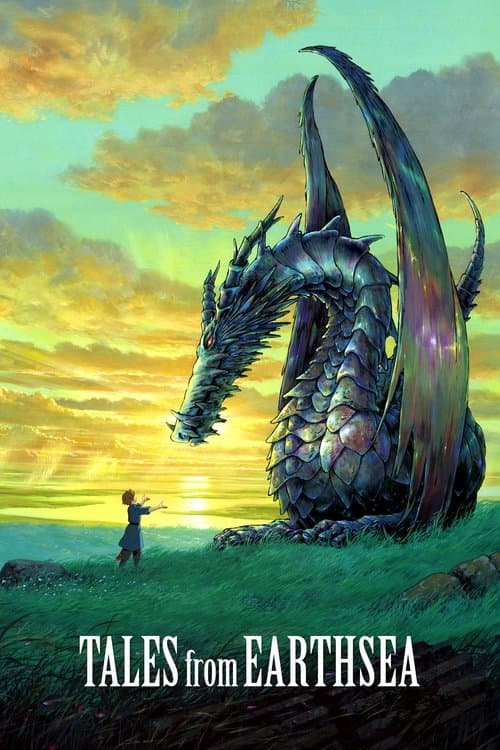
Gorō Miyazaki’s dark fantasy follows Arren, a troubled prince who flees his kingdom and crosses paths with the wizard Ged in a world where the balance between life and death has begun to fracture. As dragons reappear, shadows deepen, and a sinister force seeks control through fear and immortality, the film unfolds as both an external quest and an inward struggle over guilt, identity, and the temptation to escape suffering altogether. Its solemn tone and mythic atmosphere give the story a weight that distinguishes it from lighter fantasy adventures, even as it moves through familiar motifs of prophecy, magic, and moral trial. With its brooding mood and philosophical reach, Tales from Earthsea becomes a story about mortality, inner darkness, and the difficult wisdom that life gains meaning because it cannot be held forever.
Watch for
- How the film’s atmosphere of imbalance and unease is built through stillness, shadow, and silence, giving the world a spiritual heaviness that feels different from Ghibli’s more exuberant fantasies.
- Arren’s inner conflict, especially the way his fear, guilt, and emotional numbness shape the film just as much as its external quest and magical conflict.
- The contrast between Ged’s calm moral presence and Cob’s hunger for control, which helps frame the film’s deeper argument about mortality, fear, and the temptation to escape the limits of life.
- How the story treats fantasy not as escapist spectacle but as a setting for philosophical tension, where dragons, ruins, and prophecies all point back to the question of how a person learns to live with darkness and death.
Production notes
Tales from Earthsea was Goro Miyazaki's directorial debut — Goro is Hayao Miyazaki's eldest son, and had previously worked as a landscape designer including on the Studio Ghibli Museum in Mitaka. The decision to elevate Goro to directing was famously controversial within Studio Ghibli; Hayao reportedly disagreed with the choice and the production saw substantial father-son conflict. The film loosely adapts Ursula K. Le Guin's Earthsea novels — particularly The Farthest Shore and Tehanu — but combines elements with substantial liberty, a creative choice Le Guin herself publicly criticized. Junichi Okada voiced Arren, with Aoi Teshima as Therru and Jun Fubuki as Tenar. Composer Tamiya Terashima scored the film. Goro and Hayao were reportedly not on speaking terms during much of production, with Toshio Suzuki mediating between them; Hayao did not see the completed film before its theatrical release. The Disney English-language dub featured Timothy Dalton, Mariska Hargitay, Cheech Marin, and Willem Dafoe.
Trivia
- Tales from Earthsea was Goro Miyazaki's directorial debut and reportedly caused substantial father-son conflict during production; Hayao Miyazaki disagreed with the studio's decision to elevate his son to directing, and the two were reportedly not on speaking terms during much of production.
- Ursula K. Le Guin, the source novelist, publicly criticized the film, particularly the substantial liberties Goro Miyazaki took with her source material; she would later soften her critique somewhat after meeting with the production team.
- Goro Miyazaki had no previous animation directing experience — he had worked as a landscape designer, including substantial design work on the Studio Ghibli Museum in Mitaka — and the production became a famously demanding learning process for the new director.
- Hayao Miyazaki reportedly did not see the completed Tales from Earthsea before its theatrical release; the famously distant relationship between father and son during production was reportedly a contributing factor to ongoing conflicts at the studio.
- The film won the 'Worst Movie' award at the 2006 Bunshun Raspberry Awards (the Japanese equivalent of the Razzies); Goro Miyazaki accepted the award in person, becoming one of the few directors in history to do so.
Legacy
Tales from Earthsea is widely considered the weakest entry in the Studio Ghibli theatrical catalog — a critical and commercial disappointment that did not match Ghibli's established reputation, and whose troubled production became extensively reported in animation industry coverage. The film grossed approximately ¥7.66 billion at the Japanese box office, a financially adequate result but a creative low point relative to the studio's standards. Ursula K. Le Guin's public criticism of the adaptation, the Bunshun Raspberry Award for 'Worst Movie of 2006', and the famously distant father-son relationship during production have together made Tales from Earthsea the most discussed creative crisis in Studio Ghibli's history. Goro Miyazaki would go on to direct two more Ghibli features (From Up on Poppy Hill, Earwig and the Witch), with each subsequent project gaining more critical respect than its predecessor. Among Ghibli's films, Tales from Earthsea is the one most often cited in conversations about the difficulty of directorial succession at the studio.