The Red Turtle
Vibe
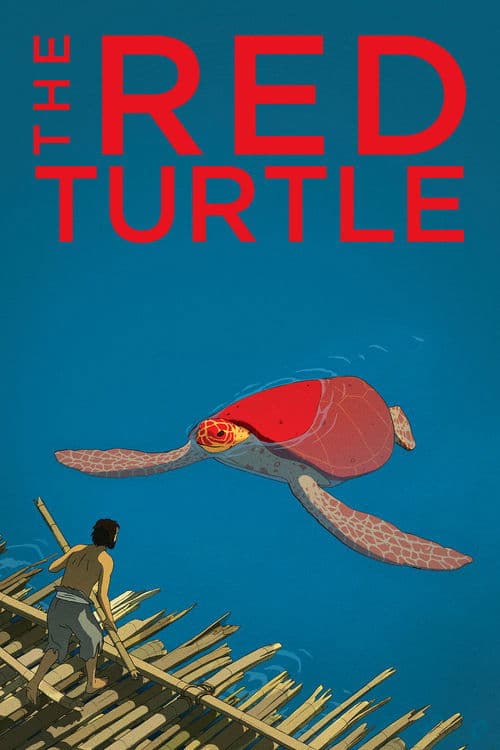
Michael Dudok de Wit’s nearly wordless fable follows a shipwrecked man stranded on a remote island, where repeated attempts to escape are interrupted by a mysterious red turtle that gradually transforms his understanding of the world around him. What begins as a survival story opens into something more elemental and contemplative, moving through solitude, companionship, parenthood, and loss with a simplicity that feels both intimate and universal. The film’s spare animation and silence give its landscapes, gestures, and passing seasons an unusual weight, allowing meaning to emerge through rhythm and observation rather than explanation. With its calm beauty and quiet emotional power, The Red Turtle becomes a story about life’s cycles, acceptance, and the fragile, miraculous bond between human beings and the natural world.
Watch for
- How the film uses silence, gesture, and the passage of time to create meaning, asking the viewer to read emotion through movement, distance, and the changing relationship between bodies and landscape.
- The red turtle itself, whose presence shifts from obstacle to mystery to something much deeper, gradually changing the film from a survival tale into a meditation on companionship and fate.
- The way seasons, weather, and natural rhythms shape the story’s emotional structure, making the island feel less like a backdrop than the living force that holds the entire film together.
- How the film’s simplicity becomes its power, stripping away dialogue and explanation so that love, parenthood, loss, and acceptance emerge with an elemental clarity.
Production notes
The Red Turtle was a French-Belgian-Japanese co-production directed by Dutch animator Michaël Dudok de Wit, who had won the Academy Award for Best Animated Short for Father and Daughter (2000). Studio Ghibli's involvement was producer Toshio Suzuki's personal initiative — Suzuki had seen Father and Daughter and reached out to Dudok de Wit to invite his collaboration. The film was the first Studio Ghibli international co-production and the first directed by a non-Japanese filmmaker. Production took approximately nine years, with the film animated primarily in France at Prima Linea Productions. The film features almost no dialogue — its narrative unfolds through gesture, music, and visual rhythm rather than spoken words — making it stylistically distinct from any other Ghibli release. Composer Laurent Perez Del Mar scored the film. The Red Turtle premiered at the 2016 Cannes Film Festival's Un Certain Regard section, where it won the Special Jury Prize.
Trivia
- The Red Turtle was Studio Ghibli's first international co-production and the first Ghibli-affiliated feature directed by a non-Japanese filmmaker; producer Toshio Suzuki personally initiated the collaboration after seeing Dudok de Wit's earlier short Father and Daughter.
- The film features essentially no dialogue — its narrative unfolds through gesture, music, and visual rhythm rather than spoken words — making it stylistically distinct from every other Ghibli feature.
- Director Michaël Dudok de Wit had previously won the Academy Award for Best Animated Short for Father and Daughter (2000); The Red Turtle was his first feature, and remains the only feature directed by a non-Japanese filmmaker in the Studio Ghibli catalog.
- The Red Turtle premiered at the 2016 Cannes Film Festival in the Un Certain Regard section, where it won the Special Jury Prize — making it one of the few Ghibli-affiliated features to receive a major Cannes award.
- The film received an Academy Award nomination for Best Animated Feature, becoming Studio Ghibli's eighth nomination in the category — although the film's status as a co-production rather than a fully Ghibli feature has occasionally led to debate about its inclusion in the studio's canonical filmography.
Legacy
The Red Turtle occupies a unique position in the Studio Ghibli catalog — the studio's only international co-production and only feature directed by a non-Japanese filmmaker. The film received warm critical reception, won the Special Jury Prize at the 2016 Cannes Film Festival's Un Certain Regard section, and earned an Academy Award nomination for Best Animated Feature. Its near-absence of dialogue and its rigorous formal sensibility distinguish it sharply from the studio's other features, and it has accumulated significant critical respect among writers interested in animation as visual storytelling rather than as narrative-driven medium. The film's commercial reach was modest — its art-cinema sensibility never reached the broad audience that Miyazaki and Takahata's films command — but its cultural reputation has continued to grow. Among Ghibli's films, The Red Turtle is the most thoroughgoing experiment in animated minimalism, and the film most often cited in conversations about how the Studio Ghibli legacy might extend into international co-production rather than purely Japanese authorial direction.