The Secret World of Arrietty
Vibe
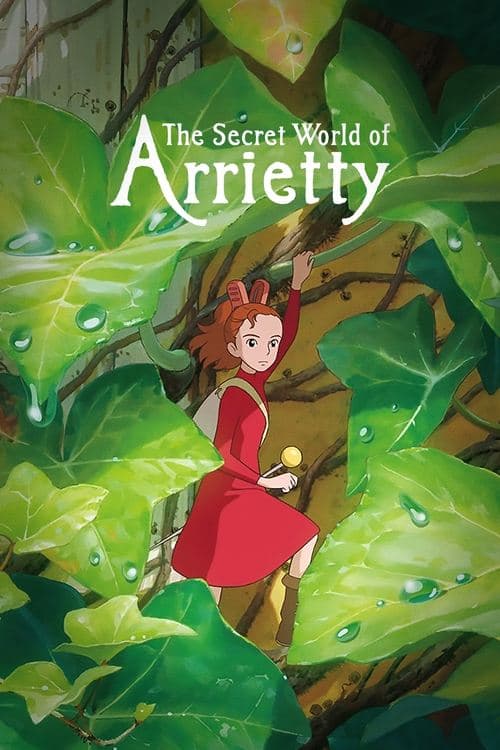
Hiromasa Yonebayashi’s delicate fantasy follows Arrietty, a tiny Borrower living in secret beneath the floorboards of a quiet house, whose careful world begins to change when she is seen by Sho, a lonely human boy recovering from illness. As their fragile friendship grows, the film builds tension not through spectacle but through scale, silence, and the constant danger that one small misstep could shatter an entire way of life. Everyday objects become landscapes, and the house itself feels transformed by the perspective of those living unseen within it. With its gentle pacing, visual precision, and emotional restraint, The Secret World of Arrietty becomes a story about survival, connection, and the bittersweet beauty of lives that briefly touch across impossible distance.
Watch for
- How the film uses scale to transform ordinary household objects into landscapes of risk and wonder, making every sugar cube, pin, floorboard, and window gap feel part of Arrietty’s lived reality.
- The quiet tension in Arrietty and Sho’s relationship, where curiosity, loneliness, and affection are always shadowed by the knowledge that contact itself may put her family in danger.
- The pacing and stillness of the house, which allow the Borrowers’ hidden existence to feel fragile and believable rather than simply whimsical.
- How the film’s emotional force comes from its restraint, letting the story of survival, visibility, and brief connection unfold through careful observation rather than dramatic overstatement.
Production notes
The Secret World of Arrietty was Hiromasa Yonebayashi's directorial debut. Yonebayashi had been a key animator at Ghibli since 1996, working on Princess Mononoke, Spirited Away, Howl's Moving Castle, and Ponyo. The project adapts Mary Norton's 1952 novel The Borrowers, which Hayao Miyazaki had been considering as a Ghibli project for over four decades. Hayao wrote the screenplay and served as planning director; Yonebayashi handled the day-to-day directorial work. The film's miniature-perspective visuals required developing new animation tools to convincingly depict the scale relationships between Borrowers and humans — a sustained technical challenge that the team addressed through extensive set-building and physical reference. Mirai Shida voiced Arrietty and Ryunosuke Kamiki played Sho. Composer Cécile Corbel scored the film with a Celtic-folk sensibility unusual for Ghibli, including original songs in French, English, Japanese, German, and Italian. The Disney English-language dub featured Bridgit Mendler as Arrietty, with David Henrie as Sho, alongside Carol Burnett, Will Arnett, and Amy Poehler.
Trivia
- Hayao Miyazaki had been considering a Ghibli adaptation of Mary Norton's The Borrowers (1952) for over four decades before The Secret World of Arrietty was finally produced; the project was reportedly first sketched out by Miyazaki in the 1970s.
- Cécile Corbel, the French Celtic-folk singer who composed and performed the soundtrack, had sent her music demo CDs to Studio Ghibli unsolicited; producer Toshio Suzuki happened to listen to them and personally chose her to score Arrietty — a famously chance meeting that produced one of Ghibli's most distinctive musical scores.
- The English-language soundtrack songs were performed by Bridgit Mendler, who at the time was a Disney Channel star; the casting was a deliberate strategy to bring younger American audiences to the film, which was one of Disney's most heavily marketed Ghibli releases.
- The film's miniature-perspective animation — the visual language of objects appearing impossibly oversized from a Borrower's vantage point — required Ghibli's animators to build physical reference models at the specific scale ratios depicted in the film.
- Hiromasa Yonebayashi, the director, would go on to leave Studio Ghibli in 2014 to co-found Studio Ponoc with several other Ghibli alumni; Studio Ponoc has subsequently produced features (Mary and the Witch's Flower, The Imaginary) that have been described as continuing Ghibli's traditional-animation legacy.
Legacy
The Secret World of Arrietty became one of Studio Ghibli's most internationally successful releases, grossing approximately ¥9.25 billion at the Japanese box office and performing strongly in Europe and North America. The film's quiet, character-driven approach and its limited romantic stakes marked it as one of Ghibli's most accessible releases for new viewers. Critically, the film received warm reviews though some critics found its narrative ambitions modest relative to Miyazaki's more thematically ambitious projects. Director Hiromasa Yonebayashi's success on Arrietty led directly to his second Ghibli feature, When Marnie Was There (2014), and ultimately to his 2014 departure with several Ghibli colleagues to co-found Studio Ponoc — a move that has been cited as one of the most significant institutional changes in late-2010s Japanese animation. Among Ghibli's films, Arrietty is the most thoroughly child-protagonist-centered without veering into the very-young register of Ponyo, making it a particularly common entry point for tweens discovering the studio.