The Wind Rises
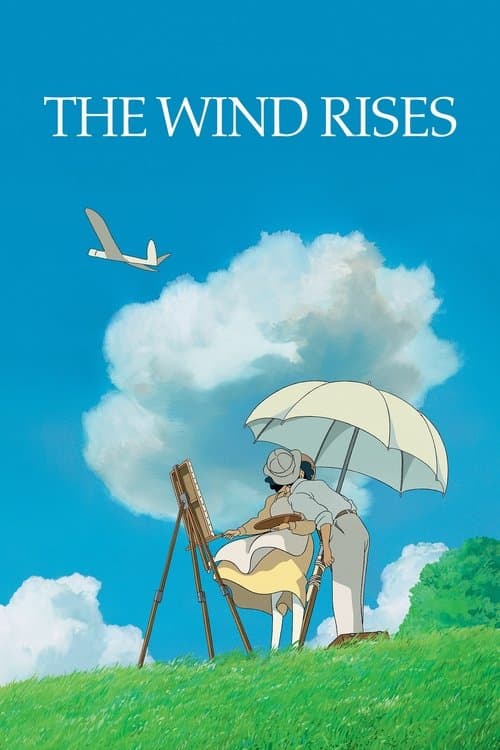
Vibe
Hayao Miyazaki’s historical drama follows Jirō Horikoshi, a gifted young engineer whose dream of designing beautiful airplanes carries him through ambition, love, and the mounting shadow of war in prewar Japan. As Jirō pursues elegance and perfection in flight while the world around him moves toward destruction, the film holds artistic longing and moral unease in constant tension, refusing to separate beauty from consequence. Miyazaki renders machines, landscapes, and dream sequences with extraordinary tenderness, turning technical fascination into something lyrical and deeply personal. With its melancholy grace and mature complexity, The Wind Rises becomes a story about creation, compromise, and the painful fragility of living fully in a world moving toward ruin.
Watch for
- How Miyazaki animates aircraft, wind, smoke, and motion with both technical fascination and emotional tenderness, making engineering feel inseparable from dreaming.
- The dream sequences with Caproni, which give the film a lyrical counterpoint to historical reality and reveal how imagination, beauty, and ambition sustain Jirō even as the world darkens around him.
- The relationship between Jirō and Nahoko, especially the way intimacy, illness, and time deepen the film’s sadness without interrupting its meditative rhythm.
- How the film keeps beauty and destruction in uneasy proximity, asking the viewer to watch not only what is being created, but what kinds of history and compromise that creation will eventually serve.
Production notes
The Wind Rises was Hayao Miyazaki's most autobiographically inflected film — a fictionalized biography of Jirō Horikoshi, the engineer who designed the Mitsubishi A6M Zero fighter aircraft used by Japan during World War II. Miyazaki had been deeply preoccupied with the moral question at the film's center: how can an artist or engineer love their craft when their craft serves a destructive purpose? The film was originally planned as Miyazaki's final feature — he announced his retirement shortly after its release, an announcement that would later be reversed for The Boy and the Heron. Joe Hisaishi composed the score. Hideaki Anno (Neon Genesis Evangelion creator and a frequent Miyazaki collaborator) voiced Jirō — an unusual casting choice given Anno was not primarily a voice actor. Miori Takimoto voiced Naoko. The Disney English-language dub featured Joseph Gordon-Levitt as Jirō, with Emily Blunt, John Krasinski, Werner Herzog, William H. Macy, and Stanley Tucci. The film took approximately five years to develop and animate.
Trivia
- Hideaki Anno — creator of Neon Genesis Evangelion and one of the most influential anime directors of his generation — voiced Jirō Horikoshi despite not being primarily a voice actor; the casting was Miyazaki's deliberate choice, drawn from a long professional friendship dating to Anno's youth-era work on Nausicaä.
- The Wind Rises was originally announced as Miyazaki's final feature; he formally retired at a press conference in September 2013, an announcement that would later be reversed when he returned for The Boy and the Heron in 2023.
- The film generated controversy in both Japan and South Korea — Japanese conservatives objected to its anti-war politics, while Korean and Chinese critics objected to what they saw as sympathetic treatment of a Japanese WWII military designer; Miyazaki defended the film publicly throughout the controversy.
- Werner Herzog plays a small but memorable role as the German engineer Castorp in the English-language dub; the casting reflected the broader prestige of the dub team and Disney's commitment to building an art-cinema English-language reception for the film.
- The Wind Rises' theatrical release coincided with significant tobacco-control public pressure in Japan; the film's many smoking scenes — Jiro and other characters smoke continuously throughout — were defended by Miyazaki as period-accurate rather than promotional, and the controversy was reported globally.
Legacy
The Wind Rises was Miyazaki's most controversial film and remains his most morally complex — a deliberately uncomfortable meditation on creative responsibility under fascism that resists easy resolution in any direction. It grossed approximately ¥11.6 billion at the Japanese box office and received an Academy Award nomination for Best Animated Feature. Critically, the film was widely celebrated; it appeared on numerous best-of-decade lists and is regularly cited as Miyazaki's most thematically ambitious work. The film's controversy in Japan, South Korea, and China — over its treatment of a Japanese WWII military designer — generated extensive critical discussion that has continued for over a decade. Miyazaki's announced retirement at the film's release made The Wind Rises function as the apparent valedictory statement of his career, a position the film had to share with The Boy and the Heron (2023) when Miyazaki returned to feature directing. Among Miyazaki's films, The Wind Rises is the one most often discussed in serious film criticism as a morally rigorous artistic statement rather than as fantasy.